CLEARING
in Wasserkirche

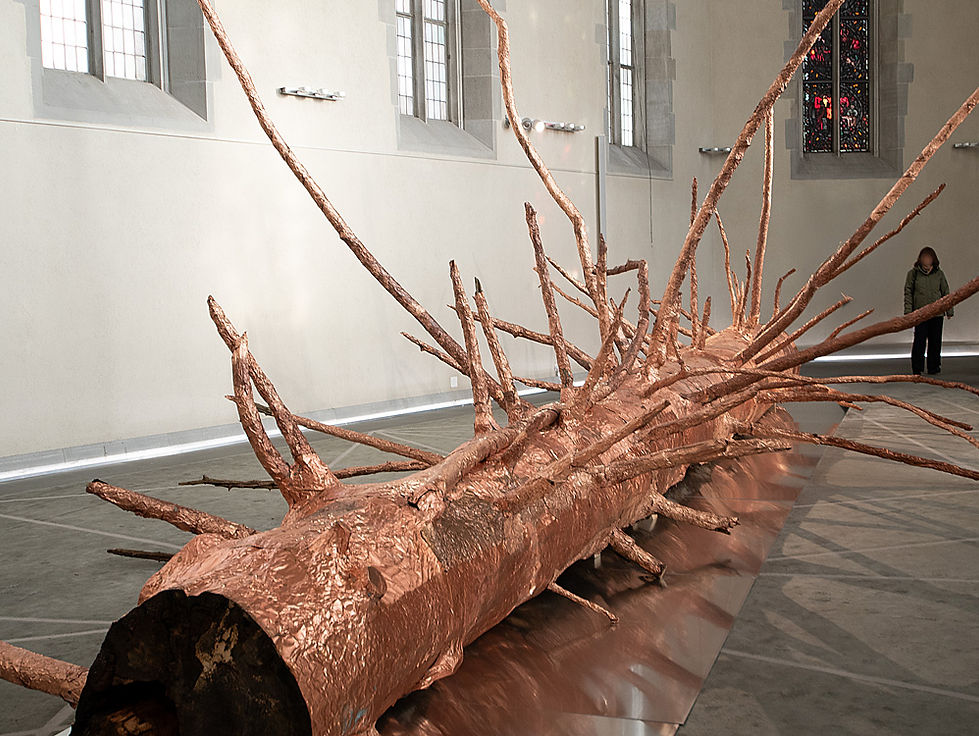
The installation CLEARING – Fallen Tree #01 was transferred from the forest of the Limmattal into the Wasserkirche in Zurich. Removed from its natural context, the tree stands within a space that carries layered time and marks an early point in the city’s formation. The Gothic architecture, shaped by reference to the forest, frames the tree and redirects attention inward. The tree does not belong to the church, yet the space accepts it, and wonder remains unresolved.
--
Die Installation CLEARING – Fallen Tree #01 wurde aus dem Wald im Limmattal in die Wasserkirche in Zürich übertragen. Aus seinem natürlichen Zusammenhang gelöst, steht der Baum nun in einem Raum, der geschichtete Zeit trägt und einen frühen Ursprung der Stadt markiert. Die gotische Architektur, selbst aus der Logik des Waldes hervorgegangen, rahmt den Baum und lenkt die Wahrnehmung nach innen. Der Baum gehört nicht zur Kirche, doch der Raum nimmt ihn auf, und Staunen bleibt ohne Auflösung.

.

.
.

.

.

.

.
EN: The installation CLEARING – Fallen Tree #01 was brought from the forest of the Limmattal into the Wasserkirche. The act of installation unfolded slowly. As the tree entered the space, its weight and length became legible in relation to the floor, the walls, and the height above. Sound shifted. Distance shortened. The space responded before the tree was fully placed.
Removed from the forest, the tree no longer stands among others. It stands within a historic room that has carried gathering, crossing, and memory. The Wasserkirche marks an early point of origin for Zurich, where movement, trade, and settlement began. Time here feels layered rather than linear. Standing beside the tree, one becomes aware of overlapping durations—growth, erosion, repair, use.
A clearing in the forest forms when a tree falls and light reaches the ground. Inside the church, the clearing takes another form. The vertical structure of the Gothic space, shaped through reference to forests, frames the tree and redirects attention inward. The tree does not belong to the church, yet the space accepts it, and wonder emerges without resolution. In the forest, questions extend outward toward surroundings. Within the church, they return toward the body. The encounter unfolds between the tree, the architecture, and the person standing there, reading time through material, space, and presence.
---
DE: Die Installation CLEARING – Fallen Tree #01 wurde aus dem Wald im Limmattal in die Wasserkirche übertragen. Der Akt der Installation vollzog sich langsam. Als der Baum in den Raum eintrat, wurden Gewicht und Länge im Verhältnis zum Boden, zu den Wänden und zur Höhe darüber lesbar. Der Klang veränderte sich. Die Distanz verkürzte sich. Der Raum reagierte, noch bevor der Baum vollständig platziert war.
Aus dem Wald entfernt, steht der Baum nicht mehr unter anderen. Er steht in einem historischen Raum, der Versammlung, Übergang und Erinnerung getragen hat. Die Wasserkirche markiert einen frühen Ursprung Zürichs, an dem Bewegung, Handel und Siedlung begannen. Zeit erscheint hier geschichtet statt linear. Im Stehen neben dem Baum wird man sich überlagernder Zeiträume bewusst – Wachstum, Abtragung, Reparatur, Nutzung.
Eine Lichtung im Wald entsteht, wenn ein Baum fällt und Licht den Boden erreicht. Im Inneren der Kirche nimmt die Lichtung eine andere Form an. Die vertikale Struktur des gotischen Raums, selbst durch den Wald geprägt, rahmt den Baum und lenkt die Aufmerksamkeit nach innen. Der Baum gehört nicht zur Kirche, doch der Raum nimmt ihn auf, und ein Gefühl von Staunen bleibt ohne Auflösung. Im Wald richten sich Fragen nach außen, zur Umgebung. In der Kirche kehren sie zum Körper zurück. Die Begegnung entfaltet sich zwischen Baum, Architektur und der Person im Raum, die Zeit durch Material, Raum und Präsenz liest.

.
Wasserkirche - one of the origins of Zurich
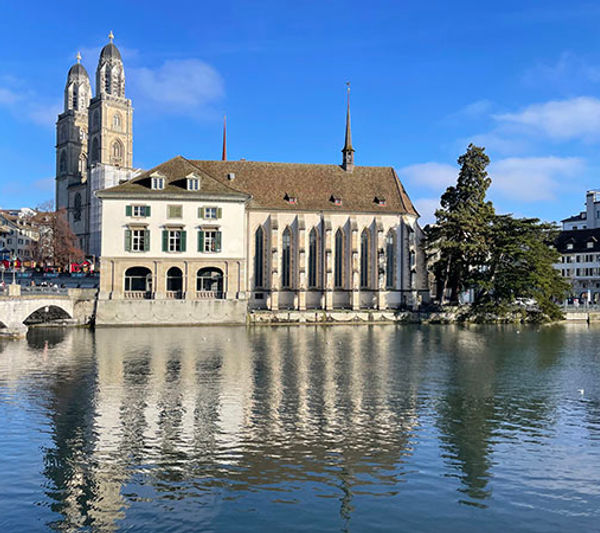
The Wasserkirche stands on one of the oldest and most significant sites in Zurich. Long before the city took its present form, this place was already a centre of belief, memory, and gathering. In this sense, the Wasserkirche can be understood as one of the origins of Zurich.
The site is closely connected to the story of the city’s patron saints, Felix and Regula. According to legend, they were early Christians who were executed for their faith. Their martyrdom became an important foundation story for Zurich, and for centuries people came to this place to remember them. Through this continuous presence, the site gained a central role in the spiritual life of the city.
Over time, the function of the Wasserkirche changed. In the 17th century, it became home to Zurich’s first public library, transforming the site into a place of learning and shared knowledge. The building was rebuilt and adapted many times, reflecting changes in religion, society, and architecture.
Today, the space beneath the church is open to visitors. It reveals layers of Zurich’s past and offers a quiet place to reflect on how the city grew — from belief and legend to knowledge, culture, and civic life.


Type:
Art Installation
Location:
Wasserkirche, Zurich, Switzerland
Status:
Completed 2025
Size
13mL x 3.5m Wx 4mH, 2mL x 2mW x 2mH
Installation:
Michel Comte Studio, Kodai and Associates
Curator:
Christoph Doswald
Team:
Yuichi Kodai, Claudia Maggi, Michel Comte
Contribution:
Art Flow - Kunst im Limattal
Esther Nägeli (Managing Director), Christoph Doswald (Curator), Simone Toellner (Communication & Media), Petra Winiger Østrup (Art Mediation), Catrina Sonderegger (Art Mediator)
Reformierte Kirche Kanton Zürich
Holzkorporation Dietikon,
Huber Krantransporte (installation in the church)
Stadt Zürich, Kanton Zürich
Lotteriefonds
Swisslos
Kanton Argau, Regionale 2025
Projektschau Limmattal
Züricher Hochschule der Künste
die Mobilar
Photo:
Yuichi Kodai & Michel Comte